
Criminal Court Cases in Hamilton County
Hamilton County has one County Court and one District Court. Both sit in the Hamilton County Courthouse at 1111 13th Street in Aurora, but they keep distinct case files. County Court handles misdemeanors, traffic matters, and early felony proceedings. District Court is the felony trial court after a case is bound over. Nebraska's JUSTICE system links the public search layer, yet the clerk for the court shown on the result remains the local custodian.
The Hamilton Clerk of District Court keeps felony pleadings and docket material. Wendy Dethlefs is the listed clerk at 402-694-3533 and P.O. Box 201. County Court Clerk Magistrate Carly Noack keeps the misdemeanor and county-level file at P.O. Box 323 and 402-694-6188. Both use the courthouse street address in Aurora.
The official district-clerk page shows the local point of contact for Hamilton County District Court records.
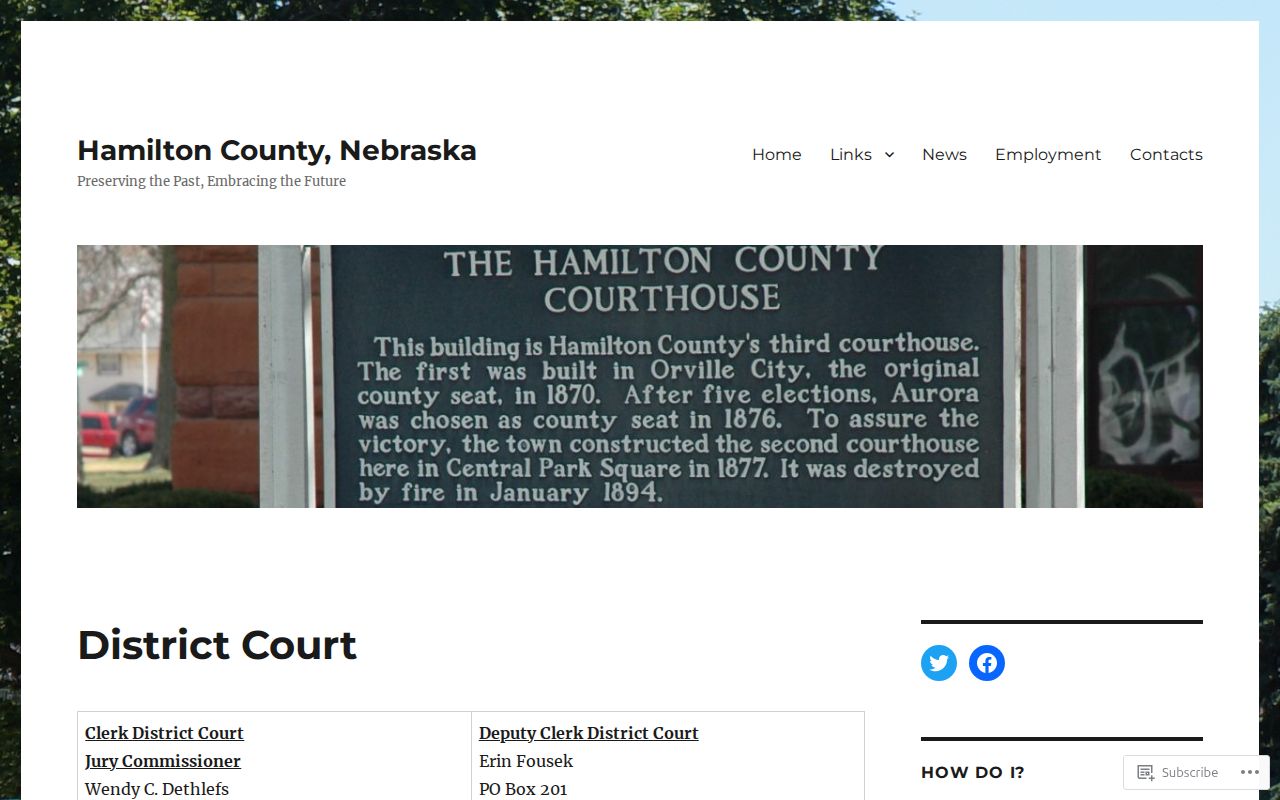
That local office is the right place to confirm a felony case number, ask about archived material, or request a certified court copy.
Hamilton County Court Jurisdiction
A court name is more than a label on a Hamilton County case record. It tells the reader where the matter stood and which clerk can produce the source file. A misdemeanor generally remains in County Court. A felony can create related entries in both courts because County Court conducts the first appearance, bond proceeding, and preliminary hearing or waiver before District Court receives the bound-over prosecution.
| Hamilton court | Criminal case role | Local clerk contact |
|---|---|---|
| County Court | Misdemeanors, traffic matters, preliminary felony proceedings, and applicable ordinance matters | 402-694-6188 |
| District Court | Filed felony trial cases after bind-over | 402-694-3533 |
The Nebraska Judicial Branch District 5 directory lists both Hamilton County courts and their judicial officers. It names District Judge Rachel A. Daugherty and County Judge Lynelle D. Homolka for Hamilton. The district spans several counties, but Hamilton filings remain tied to the Hamilton clerk and county filter.
The Judicial Branch's District 5 directory gives a visual source for Hamilton County's place in the Fifth Judicial District.
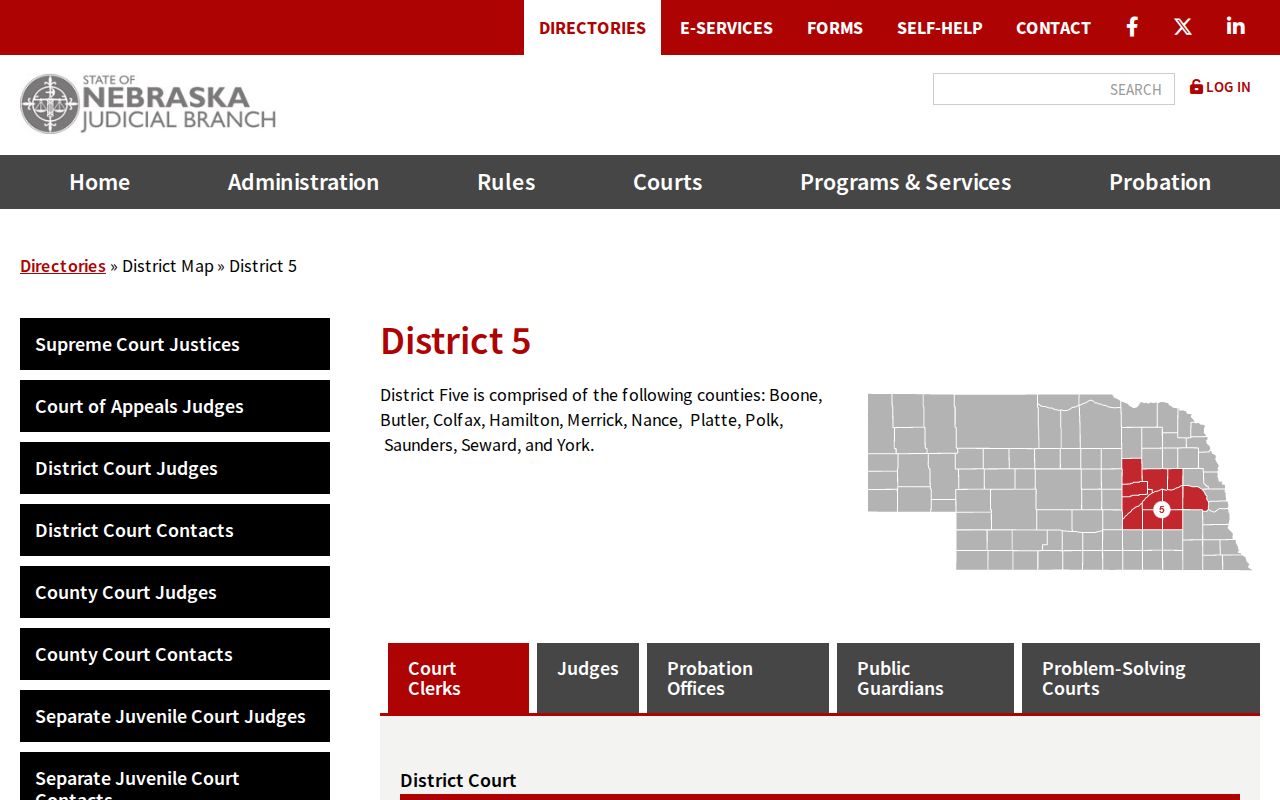
The directory helps a searcher distinguish the statewide judicial district from the county-specific record custodian.
Hamilton County Case Record Searches
The Nebraska Judicial Branch JUSTICE service is the main online discovery channel for Hamilton County trial-court cases. The live one-time party search costs $17, returns no more than 30 records, and charges even when it finds no match. Data can lag by 24 hours, and the result remains available for three calendar days. A shared name is not enough to prove identity, so compare the lawful details shown in the result and inspect both County and District Court matches.
- Open JUSTICE and choose the party-name, case-number, or other available search path that fits the facts already known.
- Enter the party name, then select Hamilton County and the likely court type to reduce unrelated statewide results.
- Narrow by case type, filing year, judge, or attorney when those facts are known.
- Open possible County and District Court matches. Read the latest register entry and the disposition for each count.
- Call the clerk shown on the case for an archived, paper, or certified copy and confirm the current fee before ordering.
| Field Label | Type | Required | Notes |
|---|---|---|---|
| Party Name | Text | Search-dependent | The one-time search is party-name based |
| Court Type | Dropdown | Optional | Choose County Court or District Court when known |
| Case Type/Subtype | Dropdown | Optional | Narrows results to the relevant JUSTICE category |
| County | Dropdown | Optional | Select Hamilton for local records |
| Year | Text/dropdown | Optional | Narrows the filing period |
| Judge | Text/dropdown | Optional | May narrow Hamilton or statewide results |
| Attorney | Text | Optional | Searches by attorney of record |
| Judgment Date | Date | Alternate search | Current $2 search or detail channel |
| Court Case Number | Text | Alternate search | Exact-number channel, currently $2 |
| Search | Button | Yes | Runs the selected query |
Subscriber access costs $100 per year for up to ten usernames. Broad searches are free, while current eServices lists case detail, judgment-date, and exact-number access at $2. Courthouse kiosks and named Nebraska law libraries offer free access. The official JUSTICE overview illustrates Nebraska trial-court case access and its service choices.
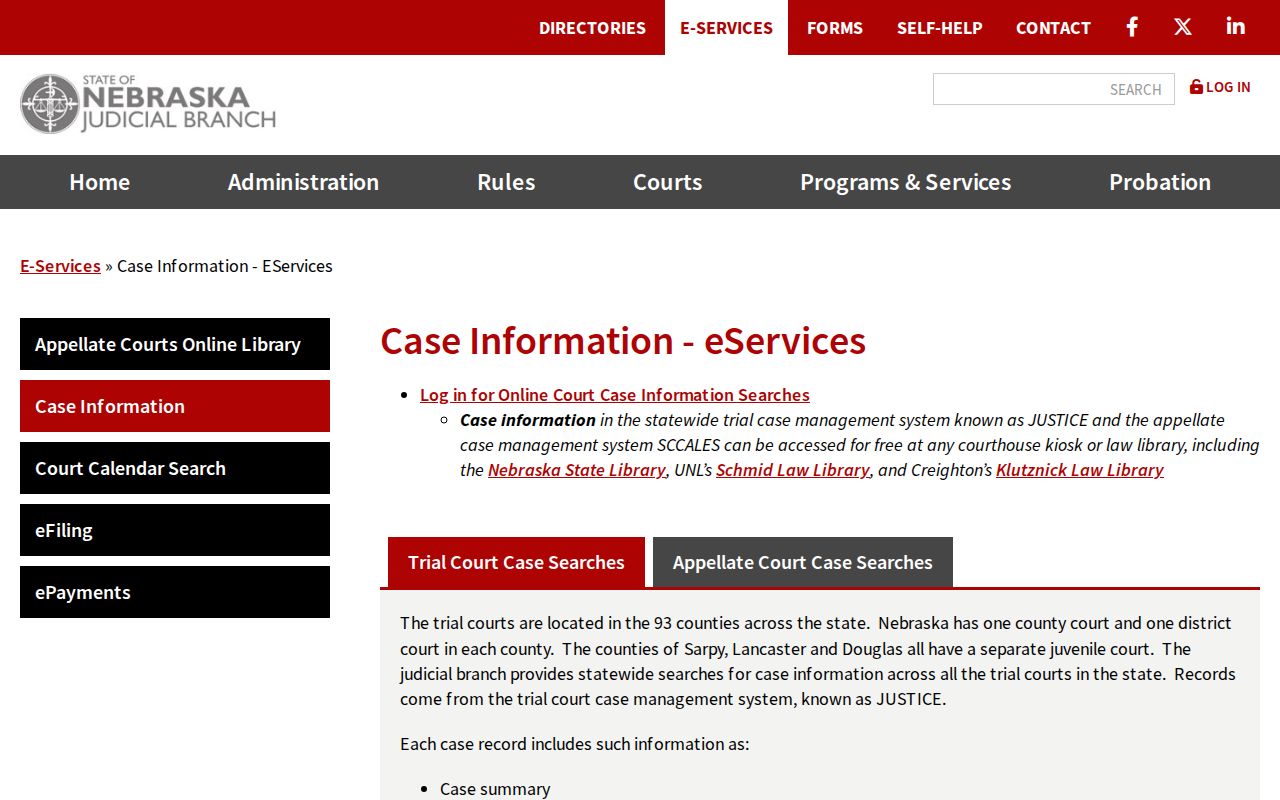
Its statewide scope is useful, but the Hamilton County and court-type filters keep a local lookup focused.
Note: The local clerks do not publish copy or certification fees, so ask for the current amount and delivery options before placing an order.
Following a Hamilton County Felony Case
One alleged felony can leave two linked Hamilton County dockets. County Court records the initial appearance, bond decision, and preliminary hearing or waiver. After bind-over, the prosecutor files the felony in District Court, where arraignment, motions, plea or trial, judgment, and sentence appear under a new case number.
Search both levels before concluding that a Hamilton County case stopped. The County Court result may end with a bind-over event rather than a final disposition. The District Court result then supplies the later counts and outcome. This is also why an initial charge should not be treated as the final offense. Prosecutors may amend or dismiss counts, and the disposition line records what happened to each filed count.
What a Criminal Case File Contains
A Hamilton County court file is a chronological account of the filed prosecution, not a broad state rap sheet. JUSTICE may show the case summary, parties, criminal offense information, money assessed and paid, register of actions, and judge notes. Images of qualifying filed documents can add the complaint, orders, journal entries, or judgment when available. The most useful fields depend on whether the goal is to identify the case, trace its path, or verify its outcome.
| Case Number & Court | Identifies the Hamilton County trial court, filing number, filing date, case type, status, and assigned judge. |
|---|---|
| Charging Document | States the filed counts, charge descriptions or statutes, offense classes, and alleged offense dates. |
| Docket Entries | The register of actions logs complaints, counsel, bond, pleas, motions, notices, journal entries, and closure events. |
| Hearing Dates | Shows an entered event date, time, hearing type, and judge when public. |
| Disposition & Judgment | Reports the plea and result for each count, the disposition date, and the court's judgment. |
| Sentence & Conditions | Records the sentence, public conditions, costs or judgments assessed, amounts paid, and balances when exposed. |
Public results can suppress protected party data. Social Security numbers, protected addresses, juvenile information, and sealed case material are not part of an ordinary public view. A blank field or missing image therefore does not always mean no source document exists.
Reading Hamilton County Case Entries
The register of actions is the dated event log for a Hamilton County criminal case. It can show when the complaint was filed, counsel appeared, bond was set, a plea was entered, a motion was decided, or judgment was imposed. It does not turn every entry into the final result. Read from the filing forward, then check the final count-level disposition and most recent entry.
- Complaint
- The initial sworn charging allegation filed in court.
- Arraignment
- The hearing at which charges are stated and a plea is taken.
- Register of actions
- The chronological list of court events and filed documents.
- Disposition
- The procedural outcome of a charge, such as conviction, acquittal, or dismissal.
- Capias
- Court process that directs a person be taken into custody.
A plea can differ from the original charge, and a case can contain several counts with different results. For that reason, the Hamilton County disposition field and judgment carry more weight than the first allegation when explaining the outcome.
Note: A filed charge is an allegation; read the final disposition for each count before describing the result of a Hamilton County case.
Criminal Case Stages in Hamilton County
A Hamilton County prosecution may begin with an arrest or citation, followed by a County Court appearance and complaint. A misdemeanor stays there. A felony may move through a preliminary hearing or waiver, bind-over, and a District Court filing. Pretrial motions come before a plea or trial. Judgment and sentence follow a conviction, with an appeal possible afterward.
Case flow: Charges Filed › Arraignment › Pretrial › Plea or Trial › Disposition › Sentencing
The flow is a reading aid, not a promise that every Hamilton County file contains each step in the same order. A dismissal can end a case before trial, while a felony bind-over can split the public trail between the two local courts.
Missing Hamilton County Court Images
A JUSTICE summary can identify a Hamilton County case even when the desired pleading is not clickable. The upgraded one-time portal describes images for qualifying documents, while subscriber case details commonly expose electronic images. Availability still varies by case. The research inventory notes that qualifying one-time images concern documents filed or uploaded after April 16, 2008, so an older or paper item may require clerk help.
First verify that the result is for the correct Hamilton court and case number. Then try free kiosk or law-library access if remote detail is incomplete. For a certified copy, an archived item, or a paper document, contact the County Court or District Court clerk that owns the file. State clearly which docket entry or document date is needed, and ask the clerk to confirm cost and delivery method.
The Judicial Branch's court-record self-help resources provide the official source context for access and record remedies.
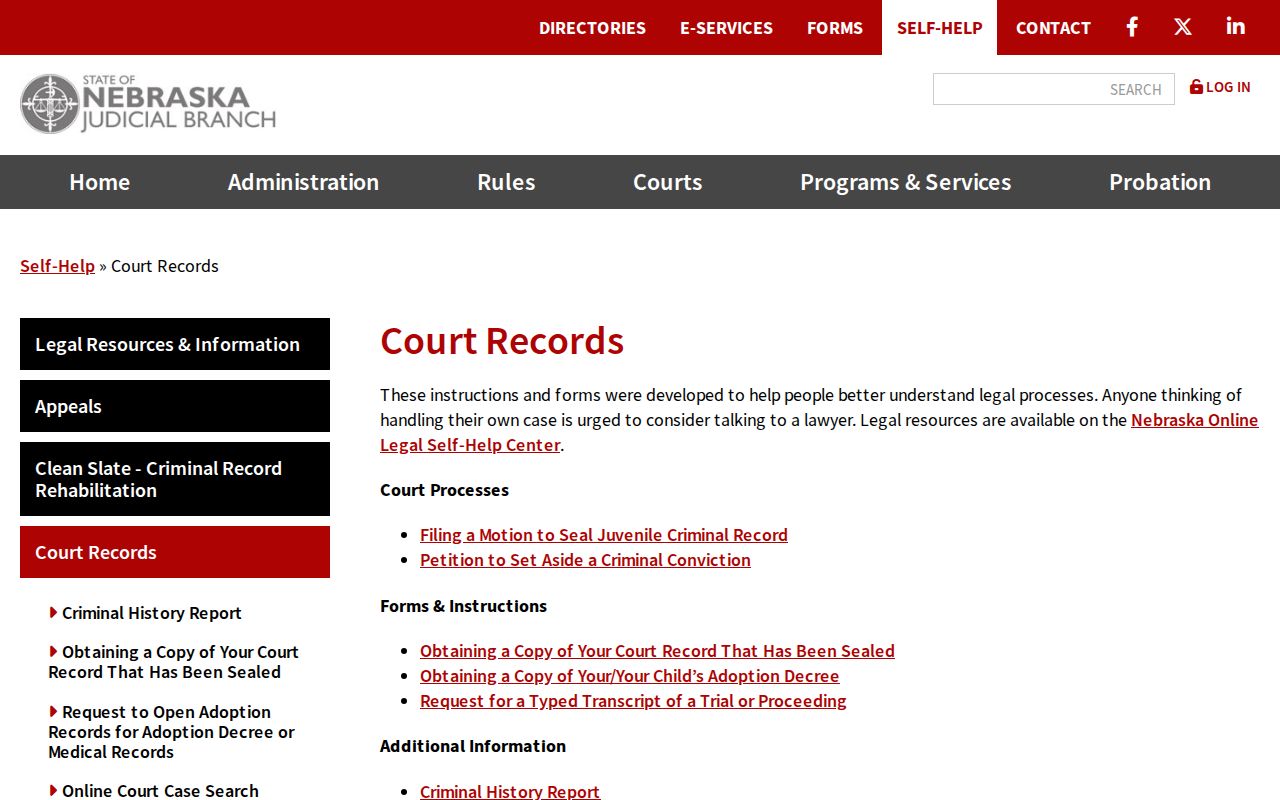
The self-help channel can point a reader toward court forms, but the Hamilton County clerk still controls local copies and certification.
Hamilton County Problem Solving Cases
The Fifth Judicial District Problem Solving Court is a named local alternative track with a Hamilton County contact at the courthouse, 402-362-6540. Entry is controlled by the court and prosecutor, so a person cannot convert an ordinary record request into program admission. When the program applies, its events can appear in the case record while the matter remains public.
Successful completion matters to later searches. Nebraska Revised Statute §29-3523 provides nonpublic treatment for specified histories after successful completion of an approved problem-solving court program and the required dismissal or notification. A later no-result response may therefore reflect a legal access rule rather than a database error. Questions about a particular file belong with the sentencing clerk or counsel, not with a broad name-search service.
Access Rules for Case Records
Nebraska Revised Statute §84-712 supports inspection and copying of public records unless another law makes the material confidential. Court access is not unlimited. Juvenile data, protected victim information, sealed records, sensitive identifiers, and information restricted by rule or statute may be withheld or redacted. The online view may also be narrower than the file available through the proper Hamilton County clerk.
If a known Hamilton County case does not appear, check the spelling, court type, county filter, and filing stage. A new entry may fall within JUSTICE's stated lag. A felony may also have moved from County Court to District Court. When those checks fail, call the clerk with the party name and any known case number or date. Do not ask the sheriff for a court judgment or the court clerk for the sheriff's incident narrative because each office holds a different record.
Some non-conviction histories become nonpublic on the timelines and events set by §29-3523. Nebraska also uses a conviction set-aside process under §29-2264, but a set-aside does not destroy every historical court record. The sentencing court is the right place to ask about the status of its order.
Note: A public no-result response can reflect a sealed or nonpublic record, a search mismatch, a filing delay, or use of the wrong court.